TL;DR
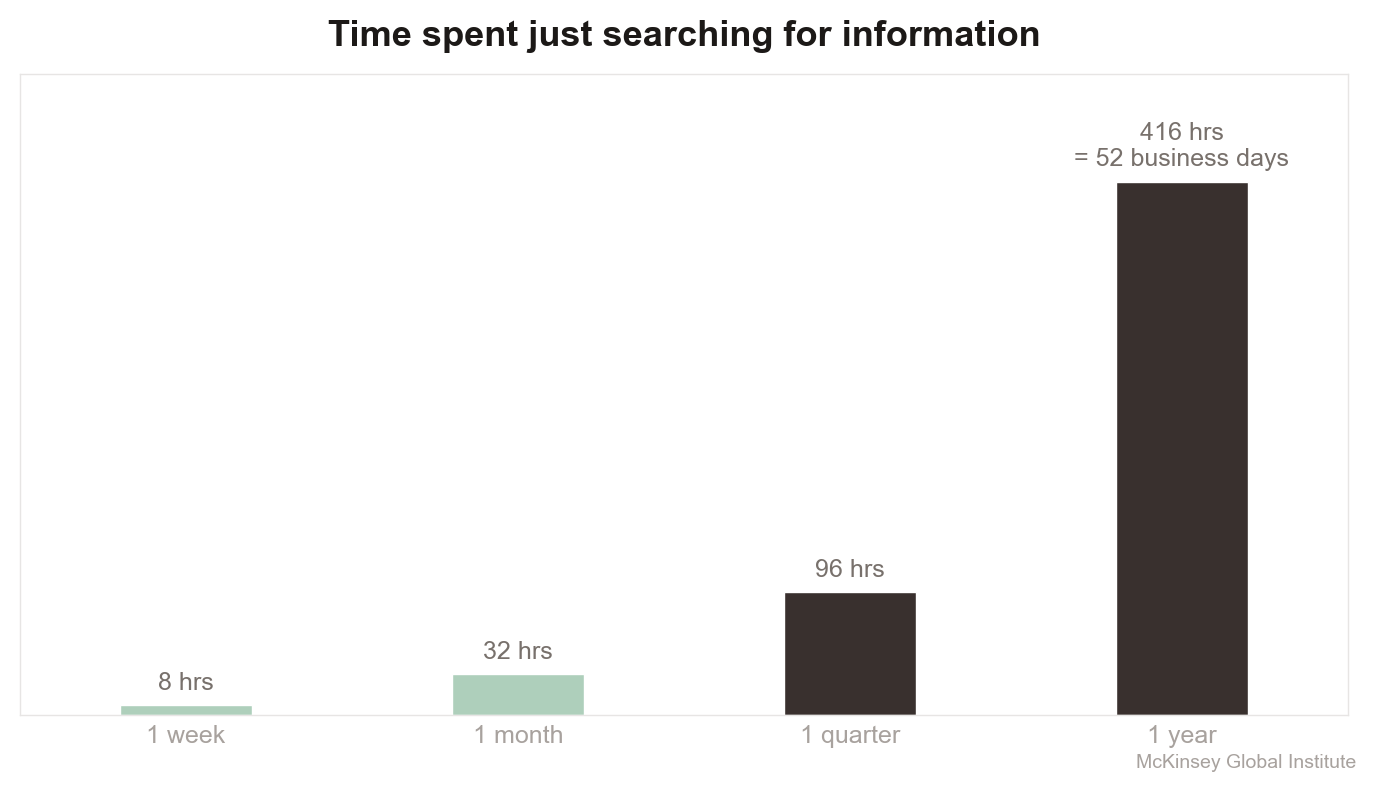
According to McKinsey, knowledge workers spend about 20% of their work hours searching for internal information and tracking down colleagues. That's roughly 8 hours out of a 40-hour week. Add Slack, email, and news monitoring on top, and the time spent on "productive work" drops below 70%. The problem isn't too much information. It's that information is scattered everywhere.
How Many Tabs Did You Open This Morning
Count your browser tabs right now.
This morning, 23 tabs were open before the first real task started. Slack, email, two competitor blogs, Hacker News, Reddit, X, three industry newsletters, and a trail of articles spawned along the way. An hour and a half gone before any actual work began.
This happens every day. Most knowledge workers have a similar routine.
The Numbers Are Worse Than You Think
According to a McKinsey Global Institute study, knowledge workers spend about 20% of their work hours searching for internal information and tracking down colleagues. Based on a 40-hour week, that's roughly 8 hours, or 1 hour 36 minutes per day.
Eight hours is a full workday. Every week, an entire day goes to "finding information."
Researchers at Rensselaer Polytechnic Institute published an open letter in Nature Human Behaviour with an even more striking finding. They estimated the global economic cost of information overload on organizations at roughly $1 trillion per year, factoring in lost productivity, delayed decisions, and burnout.
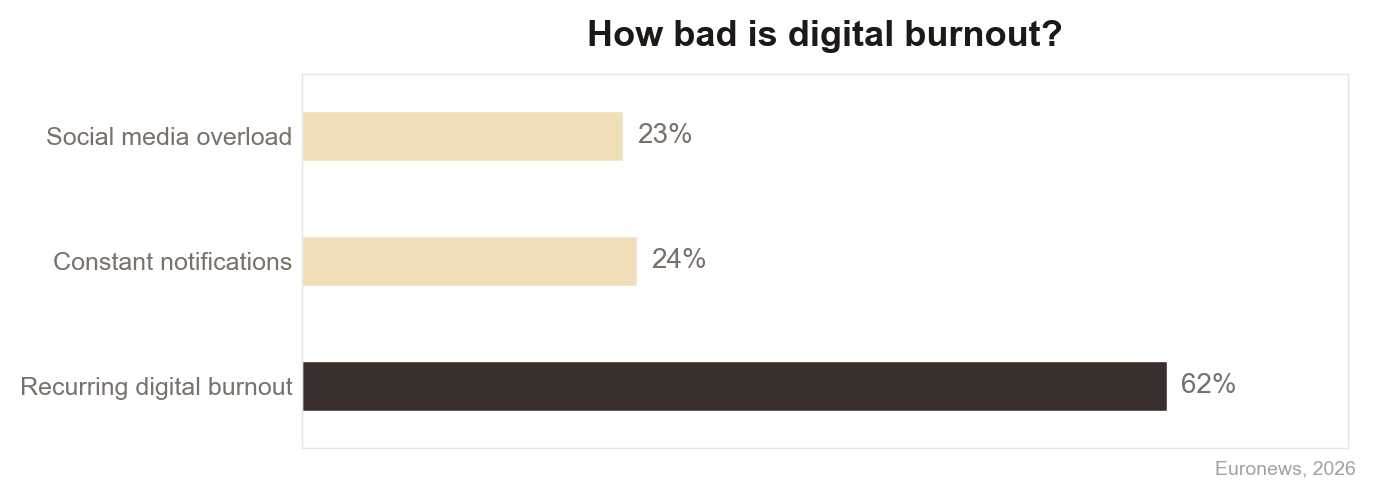
And according to a Euronews report from early 2026, 62% of people experience recurring digital burnout. 24% cite constant notifications and 23% cite social media overload as the main causes.
There's a common misconception here. People assume the problem is "too much information."
There is a lot of information. But there was a lot in 2005, and a lot in 2015. What makes today especially painful isn't the volume. It's the fragmentation.
Ten years ago, one RSS reader, one email inbox, and a few news sites could cover most of what you needed. Today, the same information is scattered across Slack, Reddit, X, YouTube, GitHub, newsletters... each with a different UI, different notification system, different update schedule.
The problem isn't the total amount. It's that information is scattered. If it were in one place, you could handle it. Spread across a dozen places, you can't.
The Trap of Real-Time Notifications
"What if I miss something important?" So the notifications stay on. Slack, email, X, Reddit. But notifications don't deliver information. They steal attention.
According to research by Professor Gloria Mark at UC Irvine, it takes an average of 23 minutes and 15 seconds to return to the original task after a single interruption. In between, you pass through two other tasks, and stress and cognitive load go up with each switch.
The cases where real-time notifications are actually needed are fewer than you think. A server goes down. A customer sends an urgent request. Beyond that, "a competitor published a new blog post" is information that can wait until later today. Finding out three hours later changes nothing.
Batch Processing Is the Answer
Why do productivity experts tell you to process email in batches? Because if you read every email as it arrives, you spend the entire day on email. Information consumption works the same way.
The idea is simple.
Pick set times to check information and only check during those windows. Turn off notifications the rest of the time. 15 minutes at 9 AM, 10 minutes after lunch. Two sessions cover most of what you need.
The problem is execution. Covering 15 sites in 15 minutes is physically impossible. Open Reddit and 5 minutes vanish. Start a YouTube video and 30 minutes are gone. Read one Slack thread and there goes 10 minutes.
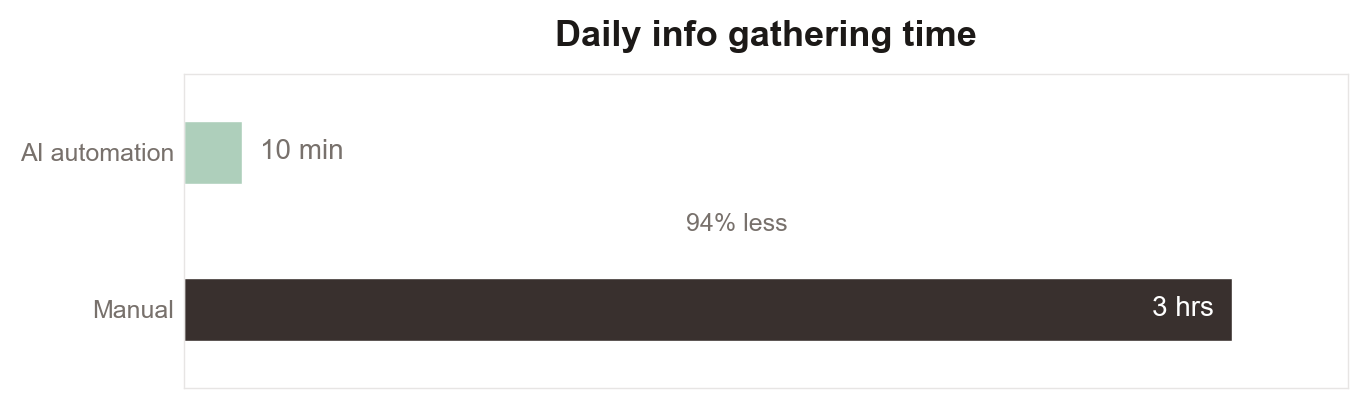
That's where AI automation comes in. Let AI monitor 15 sources overnight and have a summary of "what you need to know today" ready by morning. All you do is read the summary. 10 minutes, done.
Automating information gathering saves more than just time.
Coverage improves. People skip sources when busy, take weekends off, skim when tired. AI checks the same sources at the same time every day without fail.
Noise drops. You don't need to read everything from 15 sources. When AI filters for what matters, reading volume drops by over 90%.
And context switching disappears. Opening Reddit, then X, then YouTube, then Slack... the switching itself is cognitive load. When all source summaries are in a single digest, there's nothing to switch between.
After trying this, daily information gathering went from 3 hours to 10 minutes. That's 14 hours per week, roughly 700 hours per year. 88 business days.
Curation, Not Detox
"Digital detox" was trendy for a while. Quit social media, turn off all notifications, put down your phone.
But people who work can't cut off information. You need to know what competitors are doing, how the market is moving, how technology is changing. Going dark isn't an option.
What you need isn't disconnection. It's filtering. Sources you chose, at times you set, summarized and delivered by AI. Not detox. Curation.
Something You Can Try Right Now
Before adopting any new tool, try just one thing.
This week, time how long you spend on "information checking" every morning. Opening Slack, checking email, reading news. Set a timer. Most people discover it takes 2 to 3 times longer than they thought.
Next, pick just 5 sources that actually matter. Out of the 20 sites you check daily, keep only the ones that have actually influenced a decision. The rest can move to weekly or be dropped entirely.
Then get those 5 sources delivered as a single digest. You can set this up for free at Daigest. Connect RSS, URL, and Slack sources, set up auto-updates, and a summary will be ready every morning.
FAQ
A: That's based on McKinsey's research. It includes time spent searching emails, querying internal systems, and asking colleagues for information. External information monitoring alone easily adds 1 to 2 hours per day.
Q: Can I trust AI summaries?
A: They're not 100% accurate. Sometimes important things get missed, sometimes minor things get overemphasized. But the key is that you chose the sources AI monitors. When the inputs are trustworthy, the outputs are generally reliable too. And original links are always included, so you can verify anything that needs a closer look.
Q: Can I really turn off all real-time notifications?
A: It depends on your role. Customer support and incident response need real-time alerts. But for "industry news," "competitor moves," and "tech trends," checking once or twice a day in batch is more than enough.
Q: How is this different from a digital detox?
A: Detox means consuming less information overall. Curation means consuming information more efficiently. Not cutting off, but filtering for what matters. For working professionals, curation is more realistic than detox.


